Steam doesn't publish sales figures, and Valve's own public stats page barely scratches the surface — it shows aggregate concurrent players and not much else. Anyone trying to size up a genre, price a new release, benchmark a competitor's launch, or decide whether a game concept is even worth building has to lean on third-party tools instead. These tools estimate, track, and visualize what's happening across a catalog of well over 140,000 games, using public signals like reviews, followers, and pricing rather than Valve's internal sales ledger.
Below are five of the most useful ones, what each is actually good at, and how they tend to complement rather than replace each other.
A quick note on methodology
Almost every tool on this list is built on some variation of the Boxleiter method: a statistical technique that multiplies a game's public review count by a genre-specific factor (and its price) to approximate units sold and revenue. It was popularized by analyst Rich "Boxleiter" and refined over the years by developers like Jake Birkett and Simon Carless. It's a reasonable proxy — Valve doesn't hide review counts — but it's still an estimate with a typical margin of error in the 20–50% range, wider for niche genres and games with an unusual review-to-owner ratio (heavily wishlisted early access titles, bundle-heavy back catalog games, and free-to-play titles all break the model in different ways). Keep that in mind: the exact dollar figures each tool reports should be read as directional, not audited.
1. SteamDB
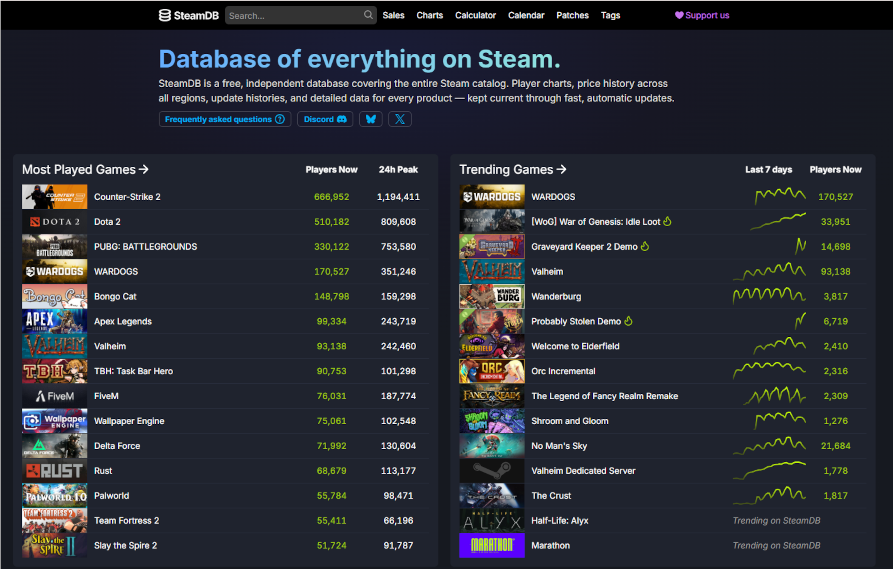
SteamDB is the tool most developers open first, and it's the closest thing to a live dashboard on top of Steam's own backend. It tracks concurrent player counts, price history across every region and currency, depot and patch changes, achievement lists, and tag/genre classifications, most of it updated in near real time. It's the natural choice for spotting a game's daily active-player trend, checking exactly when a sale started or ends, or watching what's climbing the "trending" and top-wishlisted charts right now.
SteamDB doesn't estimate sales or revenue on its main pages — its strength is precision on the data Steam actually exposes (player counts, prices, metadata), not modeled financial figures. It's free, has run continuously since 2012, and its browser extension embeds extra data (like historical low price and player count) directly onto Steam store pages as you browse.
Best for: live tracking of player counts, pricing, and store-page/backend changes.
Cost: Free.
2. Games-Stats.com
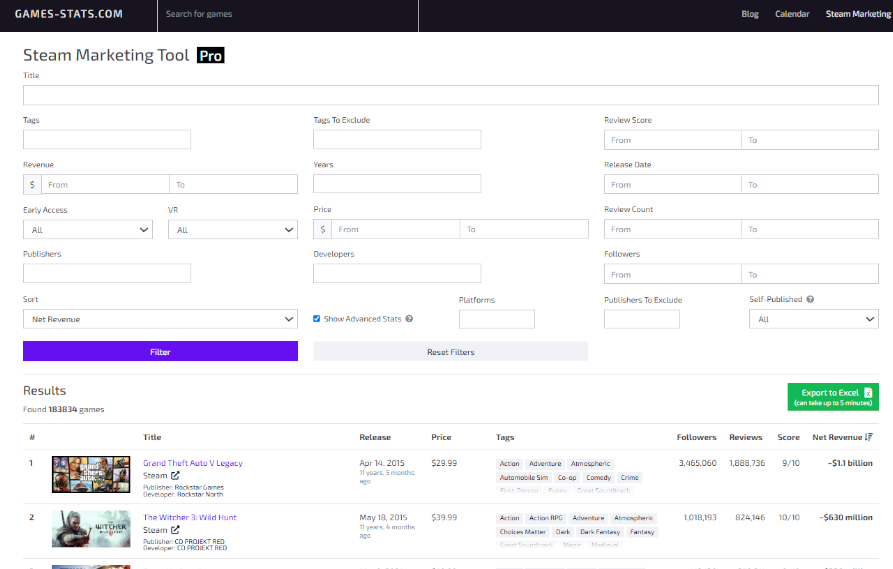
Games-Stats.com is a database and filtering tool covering essentially the entire Steam catalog: well over 140,000 titles, refreshed regularly. Where SteamDB is built around individual games, Games-Stats.com is built around large, sortable tables that let you look at the whole market at once.
Each game entry shows its release date, current and historical price (including active discounts), full tag list, follower count, review count and score, and an estimated net revenue figure calculated from those inputs. The main Steam Marketing Tool lets you sort all 140,000+ games by net revenue, price, review score, or release date, and filter down by tag, genre, and release year — so instead of checking one game at a time, you can pull up "every Roguelike released since 2022, ranked by revenue" or "every Simulation game under $20" as a single view.
Beyond that, Games-Stats.com breaks the catalog down by tag: a dedicated page lists all 477 Steam tags/genres with the number of games released under each one, plus average and median revenue per tag. That's the part that makes it genuinely useful for market research rather than just a leaderboard — it's built to answer "is this genre actually profitable, or is the revenue concentrated in two outlier hits?" rather than just "who's #1."
Filtered results can be exported to Excel, which matters if you want to build your own comparison spreadsheet rather than working inside the site's interface. A paid Pro tier unlocks additional filters and data points beyond what's available for free.
Games-Stats.com is serving indie developers and publishers specifically for competitor research and market sizing — checking how crowded a niche already is, what price points similar games converged on, and roughly what revenue a comparable title achieved, all before committing months of development time to a concept. It's less useful if you want minute-by-minute tracking of one specific game (that's SteamDB's job) and more useful when the question is shaped like "should we build this kind of game at all, where should we price it and when to release it."
Best for: catalog-wide and tag/genre-level market research, exportable revenue comparisons, competitor sizing, deep historical research on trends over the years.
Cost: Free tier with core tables and filters; Pro tier unlocks extra filters and historical data, API.
3. Video Game Insights (VG Insights)
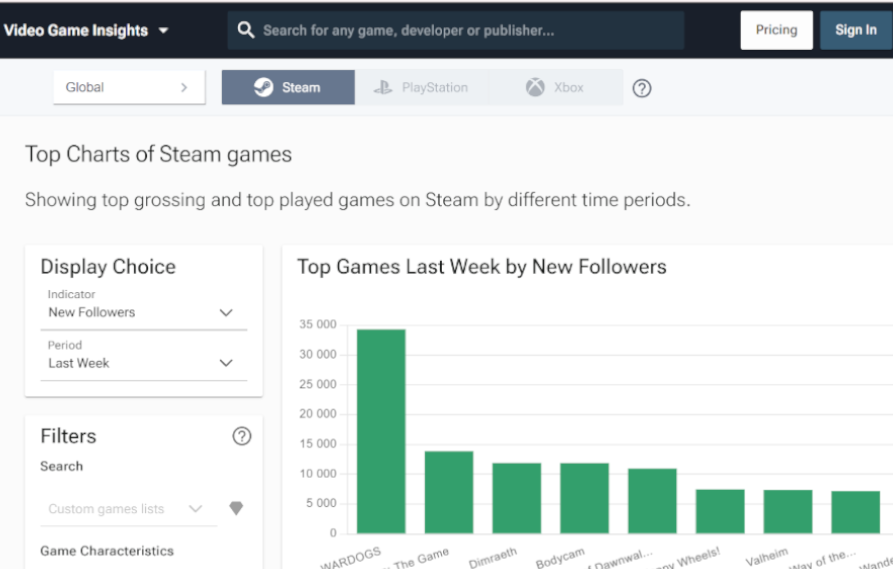
VG Insights positions itself as a customizable analytics platform rather than a single leaderboard. It offers genre analytics, a Steam Tools section that includes a unit-sales estimator and a revenue calculator aimed specifically at indie developers, and separate publisher and developer databases for competitive research. Its filtering system lets you slice the market by price band, tag, release window, or platform.
The revenue calculator is a nice touch for pre-production: you input a planned price and an expected number of units sold, and it walks the number back through Steam's cut, regional pricing effects, refunds, and taxes to show what actually lands in a developer's pocket — useful for sanity-checking a budget before a single line of code is written.
Best for: pre-production market validation, publisher/developer competitive research, budget planning.
Cost: Free tier with limited depth; paid plans for full access.
4. Gamalytic
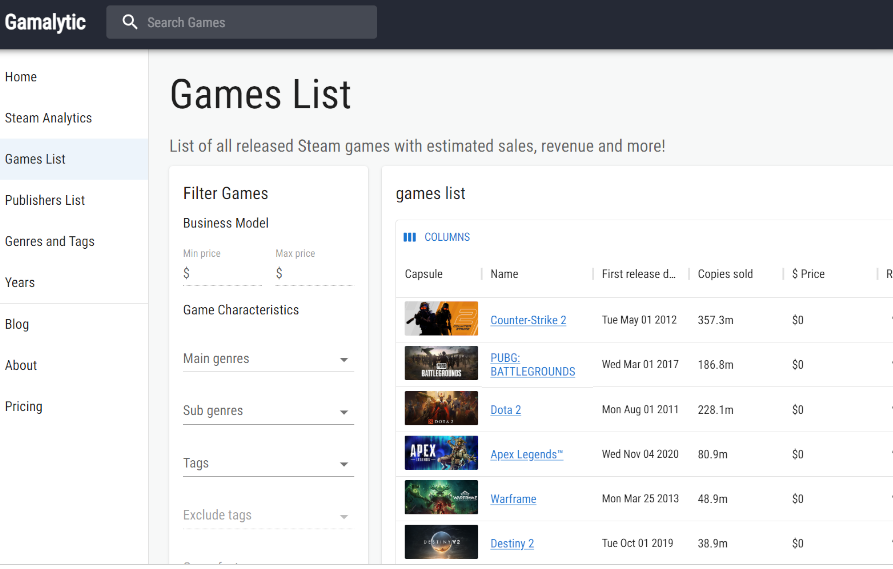
Gamalytic focuses on sales and revenue estimation with a strong emphasis on trend-spotting over time — which genres, tags, and price points are gaining or losing traction month over month, rather than a static snapshot. Like Games-Stats.com and VG Insights, its owner and revenue numbers are modeled estimates rather than figures Valve publishes, but the interface is built specifically around browsing trends rather than requiring you to manually build the comparison yourself in a spreadsheet.
Best for: spotting genre and market trends over time, rather than one-off lookups.
Cost: Free with a paid tier for deeper data.
5. SteamSpy
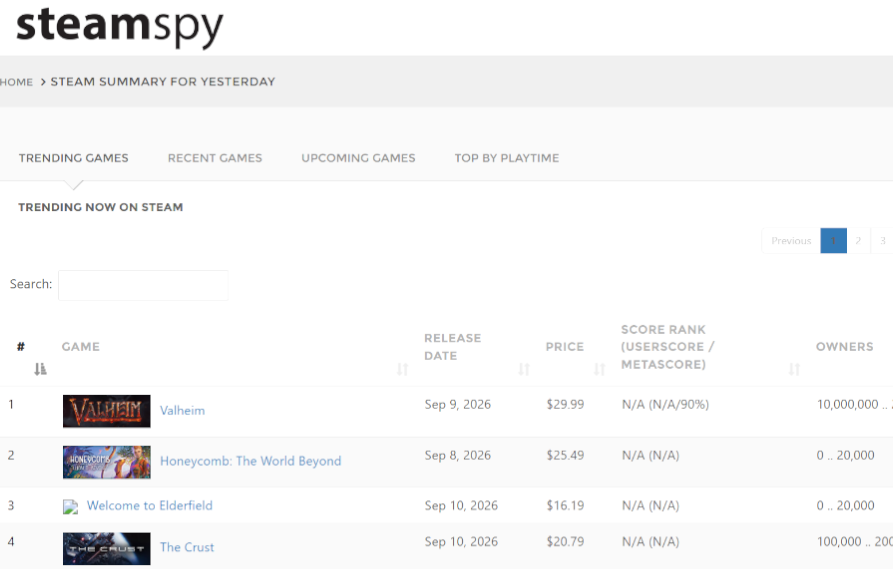
SteamSpy, launched in 2015, was the original tool for estimating Steam ownership numbers, polling public Steam profile data via the platform's API to infer how many people owned a given title. For years it was considered accurate to within roughly 10% by developers who checked it against their own real numbers. It's still useful today for quick genre breakdowns and historical top-games-by-year lists.
The caveat: its accuracy declined noticeably after Valve changed account privacy defaults in 2018, cutting off much of the profile data SteamSpy originally relied on. Its creator has always cautioned against using the numbers for financial or business-critical decisions — treat it as a rough historical reference rather than a precise figure today.
Best for: quick, free genre breakdowns and historical context.
Cost: Free.